
About me
I am a Ph.D. student in Developmental Psychology at Pennsylvania State University, working with Dr. Koraly Pérez-Edgar in the Cognition, Affect, and Temperament Lab. I am also planning to pursue a dual title degree in Social Data Analytics.
Education
 2025 to Present
 2020 to 2025
Research Interest
My research examines how children engage in social and affective processing, including how they attend to, interpret, and internalize emotionally meaningful social signals. In early childhood, these signals are conveyed primarily through key social partners, including parents and peers. I am particularly interested in the active and selective nature of this process, how it reflects children’s temperament, and how it supports adaptation to the social environment.
My work pursues two complementary aims. First, I seek to capture social and affective processing as it unfolds in everyday life. I use time intensive longitudinal methods and fine grained experimental paradigms that move beyond static self report measures, allowing me to examine how children construct meaning from social experiences in real time. Second, I aim to identify the general mechanisms and individual differences that shape this process. I develop and test theoretical models of social and affective processing across contexts. I also examine the role of temperament, particularly behavioral inhibition, in shaping how selectively and intensely children engage with social and affective information and in contributing to anxiety across childhood and adolescence.
Social Information
How children attend to, interpret, and internalize emotionally meaningful social information.
Temperament
How behavioral inhibition shapes selective engagement with social and affective information.
Adaptation
How early social experiences contribute to adaptation and anxiety across development.
For Research Methods
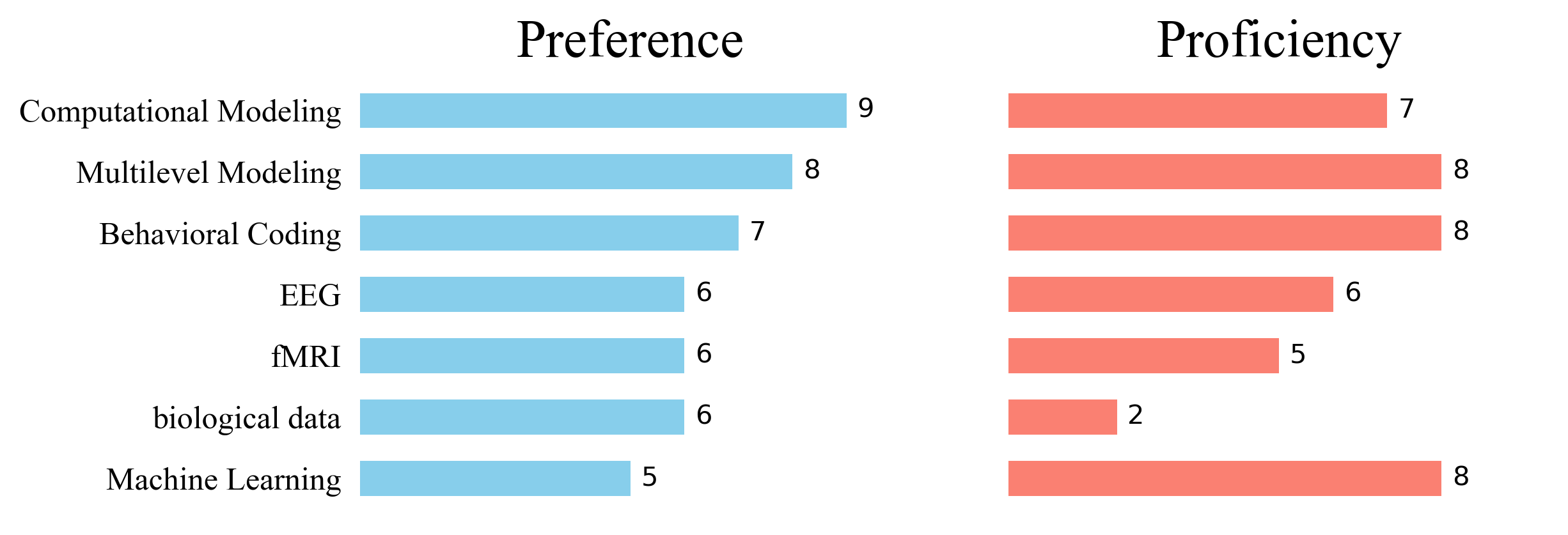
Notes: For preference, 1 means prefer not to use it, 5 means neutral and use only when necessary, and 9 means eager to use it whenever relevant. For proficiency, 1 means no prior experience, 5 means basic knowledge but not independent use, 7 means fluent use, and 9 means native level fluency.
My advisor uses a metaphor to describe research methods as languages: a mother tongue, a fluent language, a language one can read but not speak, or an unfamiliar language. I use the same metaphor to introduce my methodological training. As an early stage researcher, I consider both my preference and proficiency for each method.
Previous Experience
As an undergraduate, I worked on projects spanning developmental neuroscience, parent child relationships, social anxiety, and adolescent intervention.
- Dr. Ka Ip, University of Minnesota
Neighborhood influences on brain structure. - Dr. Zhi Li, Mt. Hope Family Center, University of Rocheste Parent child relationships and children’s sensory processing sensitivity.
- Dr. Yujia Peng, Peking University Cognitive processes in social anxiety.
- Dr. Yinyin Zang, Peking University Adolescent interventions.
Outside of research, I survive on three nutrients: board games, drums, and travel.